
Complete guide: LED color temperature and indoor atmosphere
Ambient lighting represents the soul of your interior decor. The LED color temperature is the fundamental parameter that determines whether your living room is bathed in a cozy atmosphere or your office stimulates your productivity. Measured in Kelvin (K), this technical characteristic directly influences your well-being and emotions on a daily basis.
Understanding the subtleties of color temperature allows you to transform each space according to its use. From the warm 2700K of a master bedroom to the dynamic 5000K of a workshop, each Kelvin degree tells a different story and creates a unique lighting experience.
What is color temperature in lighting?
Color temperature defines the chromatic hue of the light emitted by an LED source. This measurement, expressed in degrees Kelvin, determines whether the light appears warm (leaning toward yellow-orange) or cool (tending toward blue-white). Contrary to intuition, the higher the Kelvin value, the cooler the light appears.
This concept originates in black body physics: when a metal is heated, it emits different colors depending on its temperature. At 1800K, it glows red like a candle flame. At 6500K, it produces a white light close to that of midday sun.
The CRI (Color Rendering Index) complements this data by measuring the fidelity of color reproduction. A CRI above 80 ensures decent quality, while a CRI of 90 or more provides excellent rendering of nuances, crucial for living spaces.
Warm lighting: creating a soothing atmosphere
Temperatures between 1800K and 3000K generate warm ambient lighting, conducive to relaxation and intimacy. These golden hues stimulate melatonin production, naturally promoting preparation for sleep.
Optimal applications of warm light
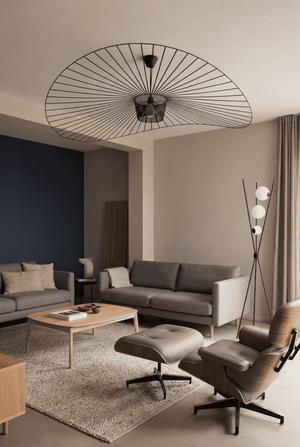
In the living room, a temperature of 2700K creates the ideal atmosphere for family evenings. Combined with a dimmer, it allows you to adjust the intensity between 50 and 150 lumens per square meter depending on the activity. Table lamps equipped with 2700K LEDs transform the space into a welcoming cocoon.
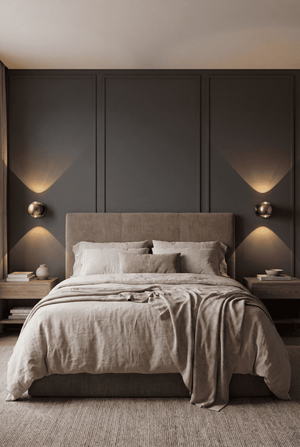
The master bedroom particularly benefits from 2400K lighting at the end of the day. This temperature promotes relaxation and prepares the body for rest. Wall sconces positioned 170-180 cm from the floor diffuse indirect light, perfect for nighttime reading.
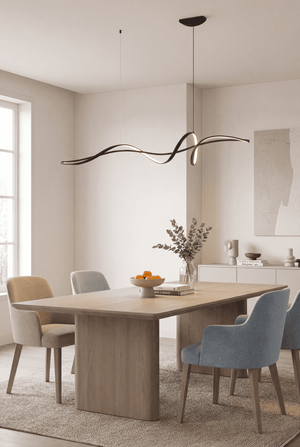
Dining areas flourish under a light of 2700K to 3000K. A pendant light installed 70-80 cm above the table creates an intimate bubble of light, enhancing the conviviality of meals.
Practical calculations for warm lighting
For a 20 m² living room, opt for a total luminous flux of 2000 to 3000 lumens distributed over several sources. Choose moderately powered LEDs (8 to 12 watts) with a 120° beam angle for even ambient lighting.
Floor lamps with dimmers allow you to adjust the lighting between 10% (soft ambiance) and 100% (functional lighting), adapting to different times of the day.
Neutral lighting: the perfect balance
The 3000K to 4000K range is the territory of neutral lighting, offering an ideal compromise between visual comfort and lighting performance. This temperature reproduces the natural midday light, keeping you alert without causing eye strain.
Areas of application for neutral light
The modern kitchen finds its optimal lighting at 3500K. This temperature ensures excellent perception of food colors while maintaining a warm atmosphere. The work surface requires 250 to 300 lumens per square meter, achievable with 7-watt GU10 LED spots spaced 60 to 80 cm apart.
Bathrooms benefit from neutral lighting at 4000K near the mirror, complemented by ambient lighting at 2700K for moments of relaxation. This duality meets the functional needs of the morning and evening relaxation.
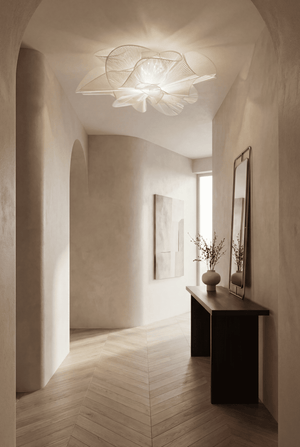
The entryway and hallways are perfectly lit with wall sconces emitting 3500K light. This temperature welcomes visitors in an atmosphere that is neither too cold nor too intimate, creating a harmonious transition to living spaces.
Cool lighting: boosting concentration and energy
Temperatures above 4000K up to 6500K generate cool, energizing light that promotes concentration. This color range suppresses melatonin production, keeping the body awake and active.
Spaces optimized by cool light
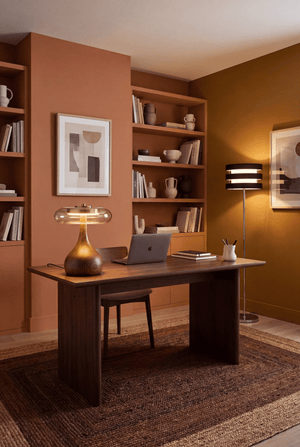
The home office reaches its full potential under lighting of 5000K to 6000K. This temperature improves concentration and reduces eye strain during detailed tasks. Direct lighting of 500 lumens per square meter on the work surface, complemented by ambient lighting at 200 lumens, creates optimal productivity conditions.
Workshops and garages require intense cool light (6000K) for precision work. High-power LED ceiling lights (30 to 50 watts) provide the necessary illumination for demanding manual activities.
The laundry room is ideally equipped with 4500K lighting, making it easier to sort laundry and perform household tasks. This temperature faithfully reveals the colors of textiles without causing glare.
Advanced lighting harmonization techniques
Mastering ambient lighting relies on chromatic consistency between the different light sources in the same space. A difference greater than 500K between two fixtures creates a disturbing visual dissonance.
Light zoning strategies
The multi-layer lighting concept combines three levels: general lighting (100-150 lm/m² for a living room), task lighting (300-500 lm/m² localized), and decorative lighting (20-50 lm/m² accent). Each layer can adopt a different temperature as long as it remains within a consistent range of 500K maximum.
Dimmable systems are revolutionizing the traditional approach by allowing simultaneous adjustment of intensity and sometimes color temperature. CCT LEDs (Color Changing Temperature) offer a range from 2700K to 6500K adjustable via remote control or app.
The integration of natural light sensors automatically optimizes color temperature according to the time and outdoor conditions. In the morning, artificial lighting starts cool (5000K) then gradually shifts to warm tones (2700K) in the evening, respecting the natural circadian rhythm.
Technical calculations for harmonization
For a 25 m² room with a 2.50 m ceiling, installing a central chandelier at 3000K (2000 lumens) complemented by four wall sconces at 2700K (400 lumens each) creates optimal light balance. The 300K difference remains imperceptible while adding depth to the lighting.
Beam angles play a crucial role: 30° for accent lighting, 60° for general lighting, 120° for ambient lighting. This distribution ensures even light coverage without shadow zones or glare.
Physiological and psychological impact of color temperature
Modern chronobiology demonstrates the direct influence of color temperature on our internal biological clock. Exposure to cool light (>4000K) in the evening delays falling asleep by an average of 30 to 60 minutes, while warm light (<3000K) promotes melatonin production from 8 p.m. onwards.
Behavioral studies reveal that spaces lit at 2700K generate social interactions that are 40% longer than those lit at 5000K. This data directly influences the design of reception and relaxation areas.
Intellectual productivity reaches its maximum under lighting of 5500K to 6000K, with a measurable 15% improvement in sustained concentration. Conversely, creativity flourishes more under lighting of 3000K to 3500K, fostering divergent thinking and innovation.
LED technologies and energy performance
Modern LED chips achieve an energy efficiency of 130 to 160 lumens per watt, saving 85% compared to traditional incandescent bulbs. The lifespan ranges from 25,000 to 50,000 hours depending on component quality and thermal management.
Tunable phosphor systems allow continuous adjustment of color temperature without loss of efficiency. This technology now equips high-end fixtures, offering total flexibility of use.
The flicker index of quality LEDs remains below 3%, eliminating eye fatigue. This technical feature, often overlooked, is crucial for prolonged workspaces.
What color temperature should you choose for a 30 m² living room?
For a 30 m² living room, choose a color temperature of 2700K to 3000K with a total luminous flux of 3000 to 4500 lumens. Distribute the lighting across several sources: a central ceiling light of 2000 lumens complemented by 2–3 accent lamps of 500 to 800 lumens each. This setup provides 100 to 150 lumens per square meter, ideal for both ambiance and functionality.
How do you calculate the number of LED spots needed for a kitchen?
For a kitchen, allow for 250 to 300 lumens per square meter on the worktop and 150 lumens/m² for general lighting. For a 15 m² kitchen, install 4 to 6 LED spots of 7 watts (500 lumens each) at a color temperature of 3500K to 4000K. Space the spots 80 to 100 cm apart to avoid shadow zones, with a beam angle of 60°.
What is the difference between a CRI of 80 and 95?
A CRI of 80 renders colors correctly for general lighting, while a CRI of 95 offers an almost perfect, true-to-life color reproduction. The difference is especially noticeable with reds and greens. For a dressing room or creative workshop, choose a CRI ≥90. For circulation areas, a CRI of 80 is sufficient and costs 30 to 40% less.
At what height should you install a pendant light above a 160 cm table?
Install your pendant light at 70–80 cm above a 160 cm table, or about 150 cm from the floor for a standard 2.5 m ceiling. This distance ensures optimal lighting of 200 to 300 lux on the tabletop without glare. For a longer table (>180 cm), consider two pendants spaced 80 to 100 cm apart or a suitable linear fixture.