
High-ceiling ceiling light: complete guide to lighting your exceptional spaces
Designing a space with a cathedral ceiling poses a particular challenge when it comes to lighting. These exceptional volumes, often found in lofts, contemporary homes, or reception areas, require a precise technical approach to create a balanced lighting ambiance without losing the intimacy of the living space.
A ceiling height above 3 meters completely transforms the perception of space and lighting needs. A suitable fixture must not only provide enough light to effectively illuminate the use area, but also visually structure these imposing volumes to create a warm atmosphere.
Understanding the specifics of high ceilings
Spaces with high ceilings have unique characteristics that directly influence fixture choice. The increased distance between the light source and the use area changes light distribution according to the inverse-square law: light intensity decreases in proportion to the square of the distance.
This physical characteristic makes it necessary to select fixtures that provide a higher luminous flux, generally between 3,000 and 8,000 lumens depending on the area to be lit. For a 25 m² living room with a 4-meter-high ceiling, you should plan for about 300 to 400 lm/m², compared with 150 lm/m² for a standard ceiling.
The beam angle also becomes crucial: a wide 120° angle covers a large floor area, while a narrower 30° angle creates accent-lighting effects. Combining several sources with complementary angles improves overall lighting uniformity.
Types of fixtures suited to great heights
Long pendant: functional elegance
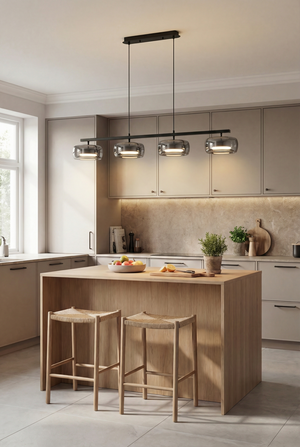
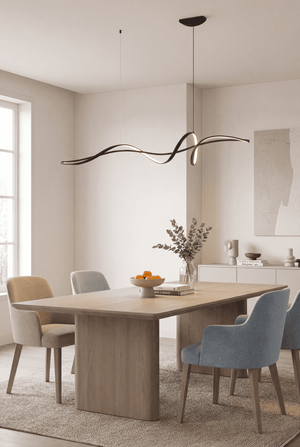
The long pendant is the most common solution for high ceilings. These fixtures, characterized by a suspension cable or chain extending beyond 1.5 meters, bring the light source closer to the area of use while maintaining a sculptural design suited to the volume.
Integrated LED models offer an exceptional lifespan of 25,000 to 50,000 hours and optimal energy efficiency. SMD technology delivers excellent color rendering with a CRI above 90, which is essential for preserving color fidelity in living spaces.
For main lighting, choose pendant lights equipped with compatible dimmers—trailing-edge technology for LEDs—so you can adjust the brightness depending on the time of day and activities.
High-ceiling chandelier: architectural prestige
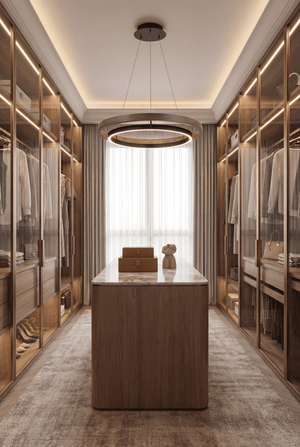
The high-ceiling chandelier is the most prestigious option for structuring an exceptional volume. These centerpiece pieces, often fitted with multiple light points, create a generous general lighting while asserting a strong decorative character.
Contemporary chandeliers integrate G9 or E14 LED sources offering an adjustable color temperature between 2700K for a warm ambience and 4000K for functional lighting. Total power generally varies between 40 and 120 watts depending on the dimensions and the number of light points.
Installation absolutely requires a reinforced ceiling support capable of supporting the weight of the light fixture, often between 15 and 40 kg for large-scale models. The recommended suspension height is between 2.20 and 2.50 meters above the floor to keep walkways clear.
Essential technical criteria
Power and luminous flux
Calculating the power needed for cathedral ceiling lighting depends on several factors: the exact height, the surface area, the color of the surfaces, and how the space is used. For a height of 4 meters, allow for a minimum of 10 watts per m² with LED technology.
Reception areas require more generous lighting, up to 15 watts per m², while bedrooms or relaxation spaces make do with 7 to 8 watts per m². This power should be distributed between the main lighting and accent lighting to create different lighting scenarios.
Color temperature directly affects the ambience: 2700K to 3000K for a warm atmosphere, 4000K for versatile neutral lighting, up to 5000K for workspaces requiring optimal concentration.
Fixing system and safety
Installing a light fixture on a high ceiling imposes particular safety constraints. The fixing point must support not only the fixture’s static weight, but also the dynamic loads linked to air movement and vibrations.
For concrete ceilings, use chemical anchors sized according to the total weight. BA13 plasterboard ceilings absolutely require a metal reinforcement or fixing to the load-bearing frame. The safety factor applied must be at least 4 times the weight of the light fixture.
The electrical system requires a cable with the appropriate cross-section: 1.5 mm² for a standard lighting circuit, 2.5 mm² if the power exceeds 2300 watts or if the run is long. Installing a dimmer requires the use of compatible dimmable LEDs.
Lighting solutions by space type
Living room and lounge with cathedral ceiling
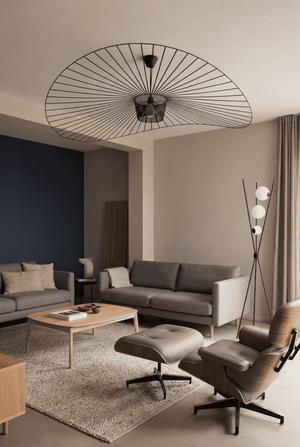
A living room with a cathedral ceiling requires layered lighting that combines multiple sources. The main fixture, usually a large pendant or a chandelier, provides general lighting with an even distribution of 150 to 200 lm/m².
Complement this main lighting with floor lamps that create focused lighting zones and table lamps for ambient lighting. This combination makes it possible to adjust the atmosphere according to activities: entertaining, reading, relaxing, or watching TV.
For open-plan spaces, position the main fixture above the conversation area, usually centered on the sofa or coffee table. The ideal hanging height is between 2.10 and 2.30 meters from the floor to preserve intimacy while structuring the space.
Entry hall and stairwell
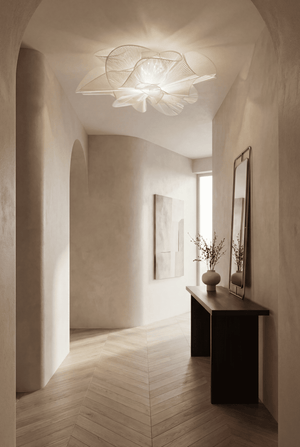
An entry hall with double height requires lighting powerful enough to ensure safety while creating a welcoming impression. A cascade pendant or a vertically developed chandelier enhances the available height while guiding the eye.
For stairwells, prioritize fixtures that provide uniform lighting across the full height. Multiple pendants at staggered heights create a decorative effect while ensuring optimal safety. Plan for at least 200 lux on steps and landings.
Installing a detection system optimizes user comfort and energy savings. Choose sensors with adjustable delay suited to the size of the space, generally between 1 and 3 minutes.
Design trends and materials
Contemporary styles
Contemporary light fixtures for high ceilings favor clean lines and premium materials. Brushed metal, stainless steel, and anodized aluminum provide optimal durability while maintaining a refined aesthetic look.
Geometric pendant lights, characterized by cubic, cylindrical, or spherical shapes, fit perfectly into modern interiors. Matte black or satin white finishes ensure decorative versatility and seamless integration with different furniture styles.
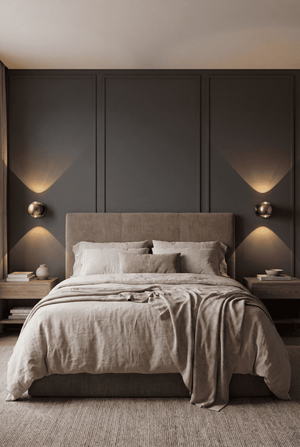
designer pendant lights incorporating invisible LED technology create spectacular lighting effects: halos of light, color gradients, or programmable dynamic lighting to match the desired atmosphere.
Premium materials and durability
The choice of materials directly influences the luminaire’s durability and its aesthetic integration. Natural brass, stainless steel, and bronze offer exceptional resistance to corrosion and retain their original appearance for decades.
Hand-blown glass lampshades diffuse a soft, even light while adding a unique tactile and visual dimension. Satin or frosted textures reduce direct glare while preserving lighting efficiency.
For contemporary environments, high-performance composite materials offer unlimited creative possibilities: organic shapes, graduated transparency, or material effects impossible to achieve with traditional materials.
Installation and maintenance
Installation preparation
Installing a high-ceiling luminaire requires careful preparation and suitable safety equipment. The use of scaffolding or an aerial work platform is necessary for heights exceeding 3.5 meters, ensuring the installer's safety and precision in mounting.
Be sure to check the load-bearing capacity of the ceiling before any installation. A reinforced concrete ceiling generally supports 100 kg/m², while a BA13 plasterboard ceiling on a metal frame does not exceed 15 kg/m² without specific reinforcement. Adapt the fixing system accordingly.
Electrical planning must take into account the exact position of the luminaire, the location of wall controls, and any dimmer. Provide a dedicated 16-amp circuit for high-power installations or those with multiple luminaires.
Maintenance and cleaning
Maintaining high-bay luminaires requires specific organization to limit interventions. Favor long-life LED sources and low-maintenance materials to space out maintenance operations.
Annual cleaning of reflective surfaces preserves lighting efficiency: a 2 mm layer of dust can reduce luminous flux by 15 to 20%. Use products suited to the material and avoid abrasive substances on delicate finishes.
Schedule maintenance operations during periods of reduced use and build up a stock of spare parts for wear components: bulbs, dimmers, and adjustable suspension systems.
Energy optimization
Lighting tall spaces is often a major energy expense. LED technology reduces consumption by 70 to 80% compared with traditional sources while providing superior lighting quality.
Installing smart management systems further optimizes savings: presence sensors, time scheduling, and automatic dimming based on natural light. These devices can deliver additional savings of 30 to 50%.
Choose light fixtures with energy certification of at least class A+ and prioritize brands offering extended warranties on LED components. The higher upfront investment pays for itself quickly thanks to operating savings.
You can complete your setup with our selection of wall sconces to create additional ambient lighting, or discover our prestige chandeliers specially designed for exceptional spaces.
Frequently asked questions
What is the minimum ceiling height to install a long pendant?
A minimum ceiling height of 3.50 meters is recommended to install a long pendant. This setup makes it possible to position the fixture 2.20 meters above the floor while keeping a 1.30-meter drop, creating the desired visual effect in tall spaces.
How do you calculate the LED wattage needed for a 5-meter ceiling?
For a 5-meter-high ceiling, plan on 12 to 15 watts of LED per m² of floor area. For a 30m² living room, allow between 360 and 450 watts spread across several fixtures. This output ensures 200 to 250 lm/m² at the use level, compensating for the loss due to distance.
What type of dimmer should you choose for a high-hanging LED pendant?
Choose a trailing-edge dimmer specially designed for LEDs, with a minimum power of 10 watts and a maximum suited to your setup. For an 80-watt pendant light, choose a 5–100 watt dimmer. Be sure to check compatibility with your LED sources to avoid flickering issues.
How can you avoid the “light well” effect in a cathedral-ceiling space?
Combine your main lighting with mid-height peripheral sources: wall sconces at 1.80 meters, tall floor lamps, and indirect lighting. This layered lighting creates a smooth transition between the ceiling and the living area, avoiding the overly stark contrast typical of the “light well” effect.