
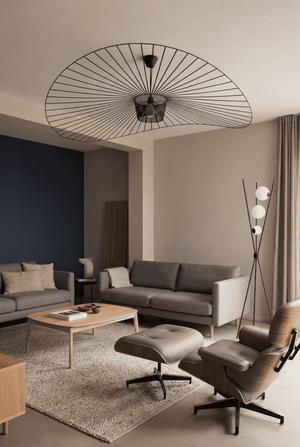

Low-ceiling light fixtures: design solutions and space optimization
Low ceilings are a major decorative challenge in many homes. Rather than putting up with this architectural constraint, you can turn this feature into an advantage with suitable lighting. Choosing a light fixture for a low ceiling requires a precise technical approach and an understanding of the lighting rules specific to this type of space.
A ceiling is considered low when it measures under 2.40 m. Under these conditions, traditional pendant lighting becomes problematic, making it necessary to rethink the entire lighting strategy. The main goal is to create a sense of spaciousness while maintaining an optimal illuminance level of 150 to 300 lm/m² depending on the activities carried out in the room.
Understanding the constraints of low ceilings
Lighting a low-ceiling space imposes strict rules on mounting height and fixture selection. The minimum distance between the floor and the lowest point of the fixture must meet a 2.10 m safety height to avoid any risk of collision. This constraint immediately rules out traditional pendant lights and naturally points toward specific lighting solutions.
The visual perception of the space is also affected by how close the ceiling is. A poorly chosen light fixture can heighten the feeling of being closed in and create an oppressive ceiling effect. Conversely, well-planned lighting can create an illusion of height and make the room look larger through plays of directed light.
The technical constraints also include managing cast shadows and achieving an even distribution of light. In a space with limited ceiling height, each light source must be positioned precisely to avoid pronounced shadow areas that would visually break up the space.
Ceiling lights suited to low-ceiling spaces
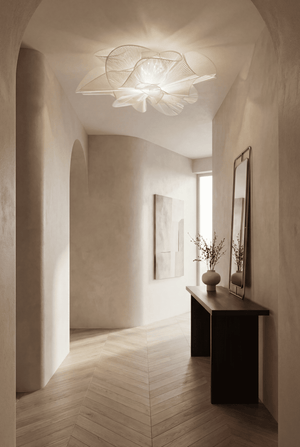
The ceiling light for low ceilings is the main lighting solution for these constrained spaces. Extra-flat models, with a height under 10 cm, help maintain maximum clearance while ensuring effective general lighting. These fixtures generally offer a 120° beam angle for optimal light distribution.
Integrated LED ceiling lights offer the advantage of compactness and energy efficiency. With a power rating of 20 to 40W and a luminous flux of 2000 to 4000 lumens, they provide sufficient lighting for a 15 to 25 m² room. The color rendering index (CRI) should ideally be above 80 to maintain high-quality color perception.
Our collection of designer ceiling lights offers models specially designed for spaces with height constraints, combining contemporary aesthetics with optimal lighting performance.
Technical selection criteria
Selecting a ceiling light for a low ceiling requires analyzing several technical parameters. The socket type directly influences installation and maintenance options. GU10 and E27 sockets remain the most versatile for this type of application, offering broad compatibility with modern LED bulbs.
Color temperature plays a crucial role in the perception of space. A warm white from 2700K to 3000K creates a cozy atmosphere but can accentuate the feeling of confinement. Conversely, a neutral white of 4000K brings freshness and contributes to the impression of a larger space.
The dimmer (dimming) function is particularly useful in low spaces to adjust brightness depending on the time of day. Ceiling lights compatible with trailing edge or leading edge dimmers allow precise adjustment from 10 to 100% of light output.
Short pendants and creative solutions
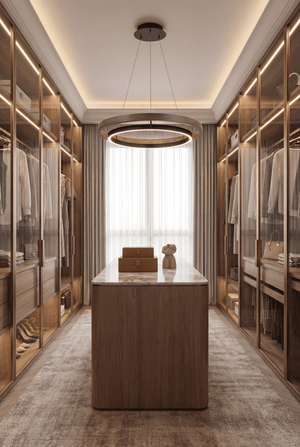
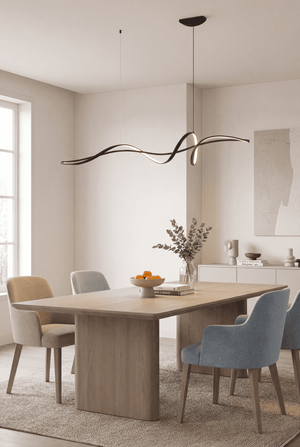
The short pendant is an appealing alternative to the traditional ceiling light, provided the height constraints are respected. These fixtures, with a suspension cable under 30 cm, preserve the pendant aesthetic while adapting to low ceilings.
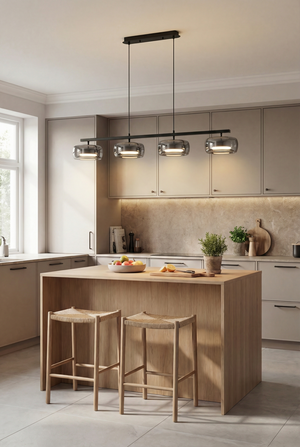
Multiple pendant lights on a track offer remarkable layout flexibility. This solution makes it possible to create modular lighting by positioning several small pendants at different heights, thus creating a dynamic visual rhythm that draws attention away from the height constraint.
Discover our selection of designer pendant lights suited to low-ceiling spaces, designed to maximize decorative impact while meeting technical constraints.
Optimized installation techniques
Installing a short pendant light requires special attention to positioning. Above a dining table, the recommended distance between the tabletop and the fixture should be between 70 and 80 cm, which requires a precise calculation based on the ceiling height and the size of the table.
Reinforced mounting systems become essential in these configurations. The weight of the fixture, concentrated at a low height, generates significant mechanical stress. Mounting to the framework or using anchors suited to the type of ceiling ensures installation safety.
Indirect lighting and wall sconces
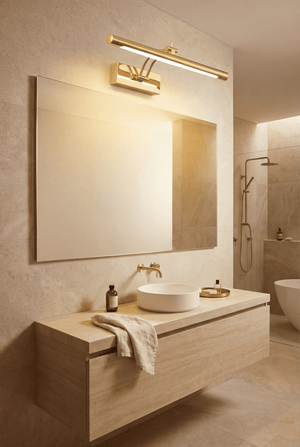
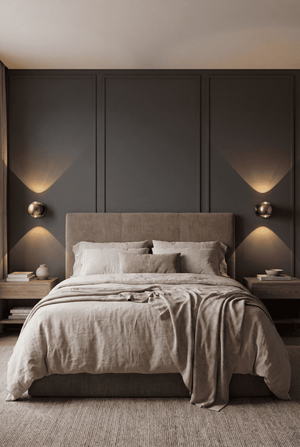
Indirect lighting is a particularly effective strategy for low ceilings. This technique involves directing light onto surfaces to create a soft reflection that lights the space without direct glare. Upward-facing wall sconces project light onto the ceiling, creating a luminous vault effect that visually enlarges the space.
Dual-emission wall sconces combine upward and downward lighting, offering an ideal balance between ambient and task lighting. Positioned at a height of 1.70 to 1.80 m from the floor, they create layered lighting that visually structures the space.
Our collection of wall sconces offers models specially designed for indirect lighting, combining technical performance and aesthetic refinement.
Strategic positioning of wall sconces
The positioning of wall sconces in a low-ceiling space follows precise rules to optimize light distribution. The spacing between two wall sconces should not exceed 3 meters to maintain continuous lighting. This distance can be reduced to 2 meters in narrow hallways to avoid shadowy areas.
The direction of the light output determines the effectiveness of indirect lighting. A 60° beam angle toward the ceiling ensures an even distribution of reflected light. Wall lights equipped with asymmetric reflectors allow you to direct the beam precisely to maximize the visual enlarging effect.
Recessed lighting solutions
Recessed lighting is the most discreet solution for low ceilings. Recessed spotlights, with a recess depth of 5 to 8 cm, disappear completely into the ceiling and free up visual space. However, this solution requires advance planning and ceiling preparation work.
LED downlights offer remarkable luminous efficiency with power ratings of 8 to 15W for an output of 600 to 1200 lumens per spotlight. Spacing between spotlights must be calculated based on ceiling height and beam angle: for a 2.20 m ceiling, 1.50 m spacing between spotlights with a 30° beam angle ensures uniform coverage.
Installation and technical constraints
Installing recessed spotlights in a low ceiling involves specific constraints. The IP20 standard applies to dry areas, but the IP44 rating becomes mandatory in bathrooms in zone 2. Thermal management is critically important, with LED spotlights requiring adequate ventilation to maintain their optimal service life of 25,000 to 50,000 hours.
LED transformers and drivers must be accessible for maintenance while remaining discreet. Remote models make it possible to place the electronics in a more accessible space, making future work easier without dismantling the ceiling.
Optimizing lighting by zones
Lighting layering makes it possible to create a lighting hierarchy that visually compensates for the height constraint. This approach involves combining several types of lighting: general, task, and ambient. In a low-ceiling living room, general lighting of 100 lm/m² complemented by 50 lm/m² of accent lighting creates a balanced atmosphere.
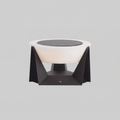
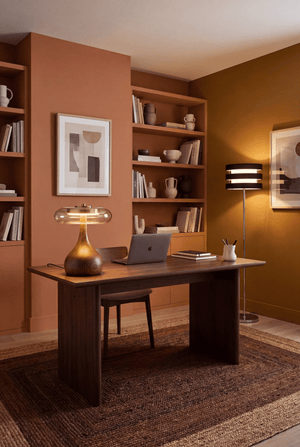
Table lamps play an essential role in this strategy by providing low-level light points that balance the overall composition. Placed on furniture or side tables, they create pools of warm light that make the space feel more human and draw attention away from the ceiling.
Explore our range of designer table lamps to complement your main lighting harmoniously and create a warm atmosphere in your home.
Suitable functional lighting
Functional lighting in low-ceiling spaces requires a particular approach to avoid direct glare. Floor lamps with a dimmer and an adjustable head make it possible to direct the light as needed without creating visual discomfort. An LED power of 15 to 25W is generally sufficient for reading light, with an output of 1200 to 2000 lumens.
Our collection of contemporary floor lamps offers models specially adapted to height constraints, with slender designs that blend harmoniously into compact spaces.
Colors and materials to make the space feel larger
The choice of the light fixture’s colors and materials directly influences the perception of space. Light and reflective finishes enhance light diffusion and create a sense of spaciousness. A ceiling light with an opal white diffuser spreads light evenly while avoiding strong contrasts that would visually shrink the space.
Transparent materials like blown glass or acrylic have the advantage of visual discretion. These materials let light pass through completely while adding a refined decorative touch. The visual lightness effect achieved helps to visually declutter the ceiling.
Metallic finishes should be chosen carefully. Polished chrome or brushed aluminum reflect light effectively, but matte finishes like black or bronze can create visual anchor points that structure the space without weighing it down.
LED technologies and energy efficiency
LED technology stands out as the optimal solution for lighting low ceilings. In addition to their remarkable energy efficiency, LEDs offer the advantage of compactness and low heat output. This characteristic prevents the creation of convection zones that could heighten the feeling of confinement.
SMD (Surface Mounted Device) LEDs offer an even light quality particularly suited to low-profile ceiling lights. With a CRI above 90, these sources preserve color rendering perfectly—crucial in a space where natural light may be limited by the architectural layout.
The exceptional lifespan of LEDs, between 25,000 and 50,000 hours depending on quality, is a major advantage in hard-to-reach installations. This longevity greatly reduces maintenance work, which is especially important to consider in low-ceiling spaces.
Frequently asked questions
What minimum height must be respected to install a light fixture?
The minimum regulatory height is 2.10 m between the floor and the lowest point of the light fixture. This safety rule applies in all passage areas. For a 2.30 m ceiling, opt for an extra-slim ceiling light under 15 cm high or recessed spotlights.
How many recessed spotlights should you plan for a 20 m² room with a low ceiling?
For a 20 m² room, plan for 6 to 8 10W spotlights distributed evenly with 1.5 m spacing between each spot. This provides 150 lm/m² of lighting, enough for a living room or bedroom. Adjust depending on how the room is used.
How can you create the illusion of a higher ceiling with lighting?
Use indirect lighting directed toward the ceiling with wall sconces aimed upward. Choose a neutral white at 4000K and avoid pendant lights. Hidden LED strips around the perimeter of the ceiling create a very effective floating ceiling effect.
What LED wattage should you choose to replace a chandelier in a room with a low ceiling?
Replace your chandelier with a 30 to 50W LED ceiling light depending on the room’s surface area. For 15 m², 30W is enough (about 3000 lumens). Choose a model with a dimmer to adjust the brightness at different times of day and create different moods.