
Eco-friendly summer lighting: cut your consumption by 80%
Summer is an exceptional time to optimize your energy use while maintaining ideal lighting comfort. With days stretching up to 16 hours of natural light in June, this season offers unique opportunities to drastically reduce your electricity bill related to lighting. Modern technologies, especially high-performance LEDs, now make it possible to achieve savings of up to 80% compared to traditional systems.
Maximize natural light to reduce artificial lighting
Summer daylight reaches its peak intensity, with values that can exceed 100,000 lux outdoors compared to just 500 lux for standard indoor lighting. This abundance of light allows you to completely rethink your home lighting strategy.
Optimizing openings is the first step in an environmentally responsible approach. Move your workstations near north-facing windows to benefit from steady, glare-free light. South-facing windows, on the other hand, provide intense brightness, ideal for main living areas between 10 a.m. and 4 p.m.
To complement this natural light, choose portable accent lamps equipped with 2700K LEDs. These supplementary lights, with a power range of 5 to 15 watts, allow you to finely adjust lighting according to sunlight exposure. A 10-watt LED table lamp produces the equivalent of a 60-watt incandescent bulb while using six times less energy.
Transform your lighting with high-efficiency LED technology
Switching to LEDs is the most cost-effective investment for environmentally responsible lighting. A modern LED offers a light output of 100 to 150 lumens per watt compared to just 15 lumens per watt for a traditional incandescent bulb.
Energy performance of the latest generation LEDs
Current LEDs convert 95% of the energy they use into light, limiting heat loss to 5%. This outstanding efficiency results in substantial savings: a 9-watt LED replaces a 60-watt halogen while offering a lifespan of 25,000 to 50,000 hours compared to 2,000 hours for halogen bulbs.
Color temperature is a crucial factor for summer lighting. Choose warm white 2700K to 3000K in relaxation areas to create a soothing atmosphere during warm evenings. Neutral white 4000K is perfect for summer kitchens and workspaces, providing energizing brightness without excess heat.
Dimmable models allow you to adjust light intensity to the specific needs of each moment. A 50% reduction in intensity results in proportional energy savings, especially appreciated during long summer evenings when soft lighting is enough.
Harness solar energy for outdoor lighting
Solar outdoor lighting is the ultimate solution for environmental responsibility. With an average summer exposure of 8 to 10 hours of sunlight per day, built-in solar panels store enough energy to power your lights for 12 to 15 hours.
Integrated photovoltaic technologies
Modern solar lights feature monocrystalline panels with efficiency above 20%. These self-contained systems store energy in lithium-ion batteries from 2000 to 5000 mAh, ensuring optimal operation even on partly cloudy days.
Stake solar path lights offer a flexible solution for marking walkways and highlighting flowerbeds. With a standard height of 40 to 80 cm and a light output of 50 to 200 lumens, they provide effective guidance while respecting the nighttime environment.
Solar LED string lights turn outdoor spaces into true light-filled showcases. A 10-meter string with 100 LEDs uses the equivalent of a traditional 5-watt bulb while running solely on solar energy.
Optimize variable lighting for tailored comfort
Variable-intensity lighting systems allow you to precisely adjust brightness to activities and times of day. This flexibility is especially useful in summer, when lighting needs vary greatly between long sunny days and extended evenings.
Floor lamps with built-in dimmers offer a modulation range from 5% to 100% of their rated power. A 25-watt floor lamp set to 30% uses only 7.5 watts while providing enough light for reading or evening conversations.
Smart programming for summer lighting
Using mechanical or electronic dimmers lets you set lighting scenarios suited to the summer rhythm. Between 8 p.m. and 10 p.m., 40% intensity is enough for outdoor dining, while 70% power is needed for cooking or reading activities.
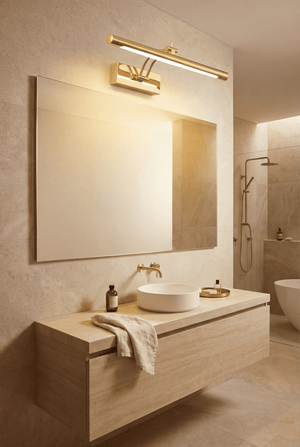
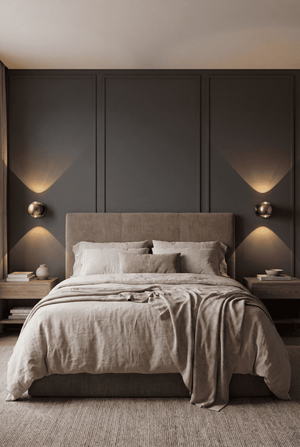
Dimmable wall lights installed at a height of 1.7 to 1.8 meters create ideal indirect lighting for transition spaces. Their low consumption of 3 to 12 watts makes them especially economical for extended use during summer evenings.
Zonal lighting strategies to maximize energy efficiency
The zonal approach means adapting lighting to the specific needs of each area rather than choosing uniform general lighting. This method can reduce overall consumption by 40 to 60% while improving visual comfort.
In living areas, choose general lighting of 100 to 150 lumens per m² supplemented by spot lighting of 300 lumens per m² in activity zones. This distribution optimizes consumption while ensuring visual comfort suited to each use.
Functional lighting for outdoor spaces
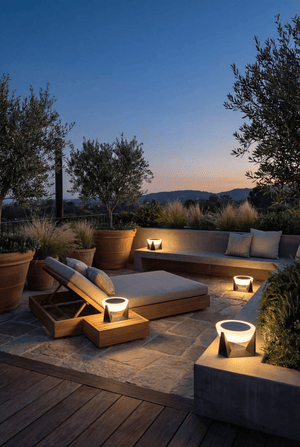
Patios and gardens require a specific approach combining safety and atmosphere. Guiding lights of 20 to 50 lumens per light point are enough to mark paths, while dining areas need 200 to 300 lumens per m² for optimal comfort.
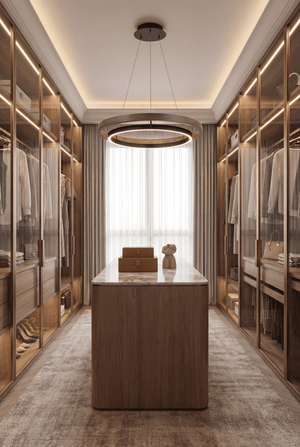
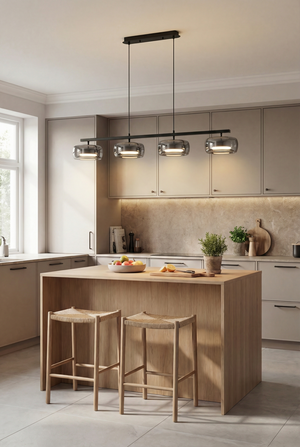
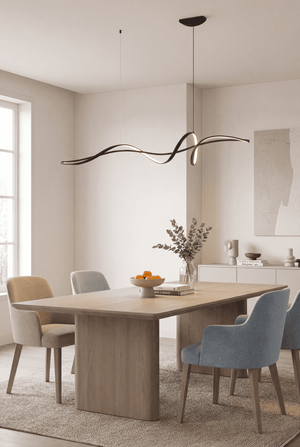
Outdoor pendant lights installed above garden tables provide both functional and decorative lighting. A 15-watt LED pendant placed 70-80 cm above the work surface produces a light output of 1200 to 1500 lumens, ideal for outdoor meals.
Automation technologies to optimize consumption
Detection and programming systems allow lighting to be automated according to actual needs, eliminating energy waste from forgetting to turn lights off. These technologies are especially effective in summer, when living habits change.
Motion detectors built into outdoor lights activate lighting only when someone passes by, reducing consumption by 70 to 90% compared to permanent lighting. With a detection range of 6 to 12 meters and an angle of 120° to 180°, these systems effectively cover passage areas.
Timed programming suited to the summer rhythm
Timers allow lighting to automatically adjust to seasonal changes. In summer, a 9 p.m. to 11 p.m. program for decorative lighting and 11 p.m. to 6 a.m. for security lighting optimizes consumption while maintaining comfort and safety.
Integrating dusk sensors automatically adjusts activation according to natural light. These devices turn on the lights when natural brightness drops below 10 to 20 lux, perfectly adapting to seasonal and weather changes.
Choosing lights based on energy efficiency
Selecting efficient lights is a lasting investment to significantly reduce your energy use. Technical criteria such as light output, color rendering index (CRI), and lifespan determine the long-term value of each fixture.
Choose lights with a light output above 100 lumens per watt and a CRI (Color Rendering Index) of at least 80 for satisfactory color rendering, ideally 90 for main living spaces.
Thermal performance and durability
Thermal management directly affects the performance and lifespan of LEDs. LED ceiling lights equipped with aluminum heat sinks maintain optimal operating temperature, preserving 95% of their initial light output after 25,000 hours of use.
Lights certified at least IP44 resist water splashes and dust, ensuring optimal durability in summer outdoor environments. This protection ensures energy performance is maintained for 15 to 20 years, more than offsetting the initial investment.
Environmentally responsible summer lighting wisely combines high-performance technologies, optimized use of natural light, and smart automation. This comprehensive approach can cut your lighting consumption by four to five times while improving lighting comfort in both indoor and outdoor spaces.
How much energy can you save by switching to LEDs in summer?
Switching to LEDs can reduce lighting consumption by 75 to 85% compared to traditional bulbs. A 9-watt LED replaces a 60-watt incandescent bulb, saving 51 watts per hour. For a household using 20 light points 4 hours a day in summer, the savings reach 408 kWh over 3 months, representing about €65 off the electricity bill.
How many hours does outdoor solar lighting work in summer?
A quality solar light works 12 to 15 hours after a summer day with 8 hours of sunlight. Lithium-ion batteries of 3000 to 5000 mAh store enough energy to power 3 to 10 watt LEDs all night. In cloudy weather, autonomy remains 8 to 10 hours thanks to the efficiency of monocrystalline panels that capture up to 20% of available solar energy.
At what height should outdoor wall lights be installed to optimize summer lighting?
Outdoor wall lights are ideally installed between 1.7 and 1.8 meters from the ground for optimal lighting of patios and paths. At this height, a 12-watt LED wall light efficiently lights an area of 8 to 12 m² with a 120° beam angle. For decorative lighting, installing at a minimum of 2.1 meters avoids glare while creating a warm atmosphere over 15 to 20 m².
What LED power should you choose to replace your old lights?
To replace a 40W incandescent bulb, choose a 5-6W LED. A 50W halogen is equivalent to a 7-8W LED, and a 75W incandescent to a 10-12W LED. In terms of light output, count 400-500 lumens to replace a 40W incandescent, 800-900 lumens for 60W, and 1200-1400 lumens for 75W. This conversion guarantees the same lighting level with 80% less consumption.